Nyadol Nyuon recently went on national television to talk about migration, race and what it means to belong in Australia.
Within days, her own belonging was being questioned.
The Australian lawyer and human rights advocate had used the ABC’s National Forum on migration to challenge ideas about assimilation and argue that the country’s increasingly heated migration debate was becoming entangled with a deeper conversation about race.
Her comments — including that there was no single “white culture” and that she had “no intention of assimilating” — triggered fierce criticism.
But the reaction did not remain confined to her ideas.
Now, a statement of solidarity spearheaded by award-winning human rights advocate and lawyer Mariam Veiszadeh is calling on Australians to stand with Nyuon and add their names to #WeStandWithNyadol.
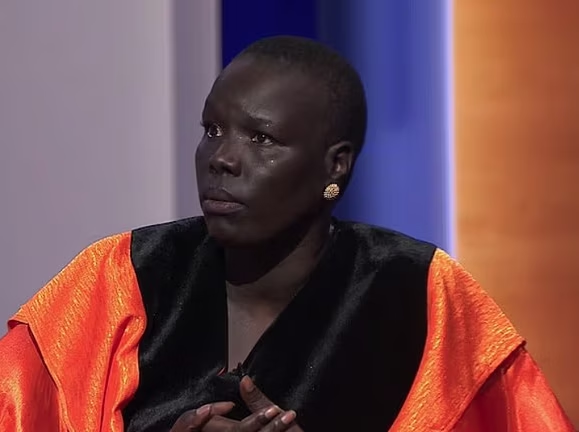
The statement says Nyuon has been subjected to “vicious online threats and racial vilification” since the ABC broadcast. Separately, migration lawyer Tina Nematian says parts of the social media response have targeted Nyuon’s background, family, ethnicity and whether she belongs in Australia.
“We have no interest in settling every argument in that debate. We are writing because of the negative commentary and backlash that has been received in response to her comments.”
The statement is explicit that its purpose is not to shield Nyuon’s views from scrutiny. Instead, it seeks to draw a line between challenging her arguments and attacking the person making them.
“We believe disagreement is legitimate but abuse is not. People can and will disagree with Nyadol’s views. Debate about migration, identity and national culture is to be expected, and a democracy is better for it. As a society, we must be able to hold these uncomfortable conversations about race and belonging without silencing or undermining those who speak them. Racist abuse, threats, and calls for someone to be expelled from the country are no longer part of a debate, but they incite hatred and harm.”
That distinction now sits at the centre of a controversy that began as a debate about migration, housing and social cohesion, but has widened into something much more personal: who gets to speak about Australian identity, who gets to challenge it — and what happens when they do.
What Nyadol Nyuon actually said
Nyuon, an Australian lawyer and human rights advocate of South Sudanese heritage who arrived in the country as a teenager, was taking part in a broader discussion about migration, housing, social cohesion and what it means to be Australian.
It was her comments about culture and assimilation that quickly became the focus of controversy.
Nyuon rejected the idea that Australia had historically been monocultural, pointing to the many First Nations that existed before European settlement and to successive waves of migration.
She also challenged the use of “Anglo-Celtic” culture in the discussion, arguing that it risked creating the impression that there was a single white culture that could be recreated in Australia.
“I’m not trying to accuse anyone here of necessarily being racist, I just think that if we start talking about terms like Anglo-Celtic and stuff, it creates this idea that there is some form of white culture that exists somewhere that can then be recreated here in Australia.”
“But there is no white culture – there is Italian culture, there is French culture, there is Argentinian culture, but there is not this notion of sort of a white culture that is being threatened.”
Addressing an earlier contribution from an audience member, Nyuon also said:
“I can say truthfully … I have no intention of assimilating.”
But the remarks that followed that statement are important to understanding her position.
“Yet I went to law school and I studied the law and I respect Australia as a country and indeed I respect the law of this country and will always do,” she said.
“But there is a difference between coming to this country and wearing something like this … and a mentality that has the ability to appreciate what Australia is. And I think the dominant amount of migrants do that.”
The comments attracted criticism, with some interpreting her rejection of assimilation and a singular “white culture” as a rejection of Australian culture.
Nyuon subsequently expanded on what she meant in a LinkedIn post.
“Apparently, saying there is no white culture has offended some people,” she wrote.
“There is no white culture as there is no black culture.”
“Black is a colour, not a culture. There are Black people. There is Ethiopian culture.”
Her stated distinction was between race and culture: that people who may be categorised by the same skin colour can belong to different cultures.
During the forum, Nyuon also spoke about her relationship with Australia.
“Many migrants deeply, deeply love this country. I love this country.”
Her views on culture, assimilation and national identity are open to disagreement.
But the controversy did not stop at disagreement with those views.
When a migration debate becomes personal
The solidarity statement says that in the days after the program was broadcast, Nyuon “has been the subject of vicious online threats and racial vilification”.
Its organisers argue that the episode exposes something larger about the way migration is discussed in Australia.
The country is accustomed to talking about migrants in numbers.
Net overseas migration. Housing demand. Infrastructure. Population growth. Labour shortages.
Those are legitimate policy questions, and governments should be accountable for the consequences of the migration settings they choose.
But there is another side of the debate that cannot be captured in a spreadsheet: what it means for the people being discussed to live here, raise families here and consider themselves Australian.
The statement argues that something changes when migrants stop being the object of the conversation and begin speaking for themselves.
“The backlash against her has revealed a profound disconnect: Australian society is comfortable discussing migrants in the abstract – as statistics and data points – but when migrants or refugees speak for themselves about the impact of the process of striving for belonging, the conversations change and the mood of the room shifts.”
Then comes one of its most confronting observations:
“Belonging is treated as a loan, repaid through performance and silence. The moment people stop performing in a grateful manner, and start naming what is broken, the door quietly closes.”
‘The reaction almost immediately validated the very point she had made’
For Tina Nematian, founder and principal lawyer of One Planet Migration, the response to Nyuon cannot easily be separated from what Nyuon had just argued.
“What has happened to Nyadol Nyuon since the ABC National Forum is almost a perfect demonstration of the point she was making,” Nematian wrote on LinkedIn on Sunday.
During the forum, Nyuon had said:
“I don’t have to look a particular way to love this country, but whenever we attempt to speak about how our belonging can look like, you meet such resistance, and the majority of the time that resistance comes from how you look.”
Nematian said parts of social media subsequently went after Nyuon’s background, family, ethnicity and whether she belonged in Australia.
“The reaction almost immediately validated the very point she had made.”
For Nematian, there is a line between debating the effects of migration and turning individual migrants into symbols of the problems Australians are experiencing.
“We can have serious conversations about migration policy, housing, infrastructure and population planning. But there is a very big difference between debating policy and turning people from particular racial or cultural backgrounds into symbols of everything supposedly going wrong in the country.”
Her assessment of what followed was pointed:
“Nyadol said the migration debate was becoming a conversation about race.
“And the response to her proved exactly why she said it.”
The price of being a ‘good refugee’
There is a reason the idea of conditional belonging resonates particularly strongly in Nyuon’s case.
Born in a refugee camp in Ethiopia after her family fled the Sudanese civil war, she spent part of her childhood in Kenya’s Kakuma refugee camp before arriving in Australia as a teenager.
She studied law, became a commercial solicitor and built a public profile as a writer, speaker and human rights advocate.
In 2022, she received the Medal of the Order of Australia for service to human rights and refugee women.
It is, on its face, an Australian success story.
But Nyuon has never told only the comfortable part of it.
She has also spent years talking publicly about racism, including the tension between being grateful to a country that gave her refuge and retaining the right to criticise that country when she believes it has failed to live up to its ideals.
The new statement places that tension at the centre of its argument.
“We believe belonging should not be conditional. Too often, refugees and migrants are welcomed while they are grateful, exceptional and quiet, and questioned the moment they name what is broken. Nyadol has never been willing to play the “good refugee” role quietly. She has kept naming racism plainly, even when she is the subject of it. No one should have to perform gratitude to be treated as an equal. Whether or not individuals agree with every detail of her account, the broader truth is undeniable: people who name structural racism rarely find the process easy or safe and are socially silenced.”
It is important not to collapse two different propositions.
Nyuon’s history as a refugee does not place her arguments beyond scrutiny.
And criticism of a refugee, migrant or person of colour is not inherently racist.
The issue raised by her supporters is what happens when criticism of an argument turns into an attack on someone’s ethnicity, family or entitlement to belong.
‘Welcome home’
Nyuon has been grappling publicly with that question for years.
Speaking at the National Press Club in 2021, she recalled arriving at Melbourne Airport in 2005 after years of displacement and presenting her Australian passport to an immigration officer.
“She inspected it and returned it to me and said, ‘Welcome home’.”
For a teenage refugee who had spent much of her life without a permanent home, those words carried profound significance.
But in the same speech, Nyuon spoke about experiencing racism in Australia and about the complicated coexistence of gratitude and exclusion.
The arc since then is difficult to miss.
The teenager who was welcomed home at Melbourne Airport would become a lawyer, receive an OAM and emerge as a nationally recognised advocate.
Two decades after arriving, she is preparing to leave.
Earlier this year, Nyuon revealed she had written to the Governor-General’s office to begin returning the OAM she received in 2022, describing it as the first step in her “slow and certain” process of leaving Australia and releasing her connections to the country.
She has also announced her intention to renounce her Australian citizenship.
Nyuon linked that decision to her experiences with Victoria University and WorkSafe Victoria.
She resigned from Victoria University in 2025 after overseeing an $800,000 WorkSafe Victoria project aimed at preventing workplace gendered violence.
The project experienced delays, strained relationships and resourcing problems. An independent evaluator later found instability and mismanagement meant it could not properly assess the program’s success.
Nyuon has separately spoken publicly about racism she says she experienced within institutions and the effect those experiences had on her.
Her allegations about her treatment should not be conflated with the independently documented problems surrounding the project.
But she has been clear about what those experiences did to her relationship with Australia.
Which makes five words she uttered during the ABC forum particularly striking:
“I love this country.”
What kind of debate does Australia want?
There are difficult questions Australia has to answer about migration.
How many people can the country sustainably accommodate? Is housing supply keeping pace? Are governments planning infrastructure adequately? What should newcomers be expected to embrace about Australian civic life? And what, if anything, does assimilation require?
Nyuon has offered her answers to some of those questions.
Others will offer very different ones.
The existence of disagreement is not the problem identified by #WeStandWithNyadol. The statement explicitly accepts debate.
Its concern is what happens when the person making an argument becomes the target.
The statement calls on the media to:
“Verify the record. Report on what she has said, not on rumour or on her family. Be vigilant with sources, and be clear about the difference between reporting and campaigning.”
Political and community leaders are urged to:
“Model the debate you want to see. Challenge her arguments if you disagree, and be equally clear in condemning abuse and dehumanising rhetoric.”
And the public is asked to consider its own role in an online pile-on:
“Before sharing a pile-on, ask whether it adds to the debate or only to the harm. And when the conversation turns from numbers to people, stay in it. Let’s not only celebrate refugees when they are winning.”
A call to stand with Nyadol
The #WeStandWithNyadol statement is signed by Mariam Veiszadeh, Emem Udo, Suresh Rajan and Back Cover Media founder and editor-in-chief Mibenge Nsenduluka.
The initial signatories are now inviting others to add their names.
Signing the statement is not presented as an endorsement of every argument Nyuon made on the ABC.
It is an endorsement of the principle its signatories place at the centre of their intervention: “disagreement is legitimate but abuse is not”.
The controversy began with an argument about migration, culture and what belonging in Australia should require.
What followed has forced another question into the debate: whether someone can challenge prevailing ideas about Australian identity without having their own Australianness put on trial.
The statement ends with a message to Nyuon:
“We see you. Thank you for your clarity, your courage and the cost they have carried. You do not stand alone.”
Now its signatories are asking Australians who share that principle to stand alongside her.
#WeStandWithNyadol
Read the full statement and add your signature to #WeStandWithNyadol